
Supreme Court Refuses to Restrict CJP’s September 5 Delhi March, Leaves Law and Order to Authorities
The Supreme Court has declined to intervene in the Cockroach Janta Party’s proposed September 5 march in Delhi, saying there were no compelling circumstances to presume violence and that authorities must decide the necessary law-and-order arrangements.
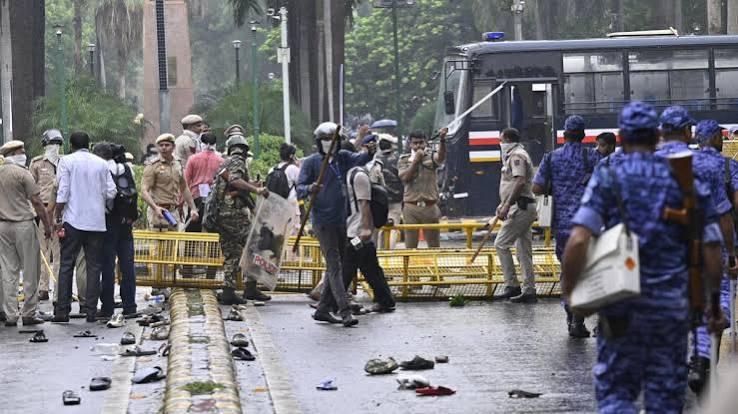
Supreme Court Refuses to Restrict CJP’s September 5 Delhi March, Leaves Law and Order to Authorities
The Supreme Court on Monday refused to impose restrictions on the proposed September 5 protest march in Delhi by the Cockroach Janta Party (CJP), leaving decisions on permissions and security arrangements to the Centre and Delhi governments.
A bench headed by Chief Justice of India Surya Kant, along with Justices Joymalya Bagchi and V Mohana, said there were no “compelling circumstances” before it to assume that the proposed mobilisation would become violent.
The court said it expected all participants to remain peaceful, follow the law and respect the rights of others.
Supreme Court Leaves Law-and-Order Decisions to Government
The court was hearing petitions filed by Shivam Upadhyay and retired Delhi Police officer Rajendra Singh seeking restrictions on large-scale demonstrations and organised marches in security-sensitive areas of central Delhi, including India Gate and Central Vista.
The petitioners also sought postponement or modification of the September 5 march until after the BRICS Summit, scheduled to take place in Delhi on September 12 and 13.
Representing Singh, advocate Rizwan Ahmad argued that the organisers had announced another march without obtaining police permission.
He contended that a large gathering in the capital ahead of an international summit could create security concerns and urged the court to defer the protest.
The bench, however, said questions concerning law and order were primarily for the relevant authorities.
It directed that copies of the petitions be served on the Centre and Delhi governments, which would be responsible for determining what was lawful and what security measures were required.
Court Says Protesters Expected to Remain Peaceful
The Supreme Court said it had no reason at this stage to believe that the march would result in violence.
The bench expressed confidence that participants would comply with legal and regulatory requirements and respect the fundamental and statutory rights of others.
The court also said that if an alarming or untoward situation emerged, the petitioners could approach it again, provided the issue involved a matter falling within its judicial domain.
September 5 March Announced by CJP
The proposed three-kilometre march was announced by the CJP on August 24.
The group has described it as a peaceful mobilisation from India Gate to the Delhi Police headquarters.
According to the organisers, the march is being supported by families of students who died by suicide following the cancellation and subsequent re-test of the National Eligibility cum Entrance Test (NEET), along with people alleging police excesses during the July 20 agitation.
The protesters are also demanding action over what they describe as the Centre's failure to honour assurances made on July 25, which had contributed to the withdrawal of the group's 36-day protest at Jantar Mantar.
The All India Students’ Association has extended support to the proposed march and backed demands including withdrawal of FIRs against student protesters and an investigation into allegations concerning the use of force during the earlier demonstrations.
Supreme Court's Panel Probing July 20 Violence
The court's decision comes as a five-member high-powered enquiry committee (HPEC) prepares to investigate competing allegations arising from the July 20 protest.
The Supreme Court constituted the committee on August 18 after observing that allegations of excessive force during the protest prima facie warranted an independent inquiry.
The panel is headed by former Supreme Court judge Justice R Subhash Reddy.
Its members include former Punjab and Haryana High Court Chief Justice Ravi Shankar Jha, former Delhi High Court judge Shalinder Kaur, former CBI director Rishi Kumar Shukla and retired Meghalaya DGP LR Bishnoi.
HPEC to Examine Allegations From Both Sides
The committee has been tasked with examining allegations of police excesses as well as claims concerning violence by protesters, injuries to police personnel and damage to public property.
Its mandate includes examining allegations relating to the use of pellet guns, electric batons, lathis and tear gas, along with the proportionality of police action.
The panel will also examine issues concerning prohibitory orders, surveillance of protesters and the use of Section 152 of the Bharatiya Nyaya Sanhita.
Allegations of targeted violence, harassment and molestation of women protesters, as well as medical and other assistance provided to affected people, also fall within its scope.
The committee has been directed to preserve and examine CCTV footage, drone recordings, body-worn camera footage, videography, wireless communication records and PCR call logs related to the protests.
It can also receive documentary evidence and representations from affected individuals and allow anonymous complaints where necessary to protect complainants and witnesses.
Court Directs Petitioners to Approach Inquiry Panel
During Monday's hearing, one of the petitioners' lawyers sought a broader investigation into the July 20 events, including allegations of unlawful assembly, injuries to police personnel and damage to government property.
The bench directed the petitioners to place their representations before the HPEC.
The court described the committee as a “neutral umpire” that would examine the relevant issues and make recommendations before further directions are considered.
The bench also reiterated that the committee's work would remain under the Supreme Court's supervision.
The connected petitions have been posted for September 10, with copies also directed to be served on the HPEC.
The Centre and Delhi government have said they have no objection to an independent and fair inquiry while denying allegations of police excesses.
Tags
More Stories
Karnataka Minister B Nagendra Resigns From Cabinet and MLA Post Amid Valmiki Corporation Irregularity Row
28 Aug 2026
Punjab Employees’ Strike Turns Chaotic in Jalandhar as CM Bhagwant Mann Cancels Scheduled Talks
28 Aug 2026

Why Doesn't PM Modi Hold Press Conferences? Kiren Rijiju Explains
27 Aug 2026
Modi 3.0 Cabinet Reshuffle: Who May Stay, Exit and Join the Union Cabinet?
26 Aug 2026